5 Signs Your Spreadsheet System is Secretly Killing Your Shop’s Profit Margins
This article was written by Ian Creswell, Passport Software’s Executive Vice President/Manufacturing Product Manager—we hope you find it useful.
Most small manufacturers start out managing inventory and scheduling in Excel. It works fine until it suddenly doesn’t. At that point, spreadsheets can limit your ability to grow. This post speaks to the exact moment folks realize it’s time to move beyond manual processes.
Sign #1: The “Ghost Inventory” Nightmare
Your spreadsheet says you have 50 units of a critical raw material in stock. The job is scheduled for Tuesday. Tuesday morning arrives, the operator goes to the shelf, and it’s completely empty.
Why does this happen? Manual inventory logs rely on human memory and can be difficult to update in a timely fashion. If someone pulls material for a rush job and forgets to update the shared sheet, the data is instantly corrupted. Without proper visibility, you won’t catch this mistake until it’s too late.
Production grinds to a halt. You either have to pay expedited shipping fees to rush materials in, or push back the customer’s delivery date—damaging your reputation.
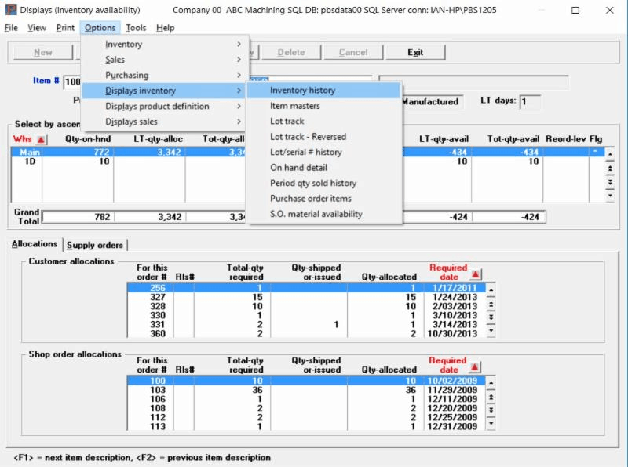
Effective manufacturing ERP for small businesses can solve this issue, providing real-time inventory visibility. This allows you to have necessary materials available for on-time deliveries.
Sign #2: The “Where is that Order?” Scavenger Hunt
A major customer calls asking for a status update on Order #402. Your front office has no idea. They have to physically walk out to the shop floor, find the supervisor, hunt down the paper traveler, and guess how close it is to completion.
Why does this happen? Spreadsheets are static because they can’t track a job moving through work centers (e.g., cutting, welding, finishing) in real time. Valuable labor hours are wasted playing detective. Worse, it makes your shop look disorganized to high-value clients who expect instant answers.
Small business manufacturing software streamlines your operations from end-to-end, so you have visibility across all levels of production.
Sign #3: The “Gut-Feeling” Quote (That loses money)
You’re bidding on a new contract. You look at an old spreadsheet from six months ago, guess the material costs, throw in an estimate for labor hours, and submit the bid.
Why does this happen? Excel doesn’t automatically track your actual machine setup times, labor variances, or fluctuating material costs from recent jobs. You’re pricing based on theory, not reality. You win the bid, but halfway through production, you realize material prices went up 12% and the setup took twice as long. You just paid out of pocket to do a job for a customer.
Effective manufacturing ERP for small businesses improves purchasing, allowing you to set up alternate vendors in the system. It also allows you to better calculate job costing with real-time data.
Sign #4: Death by Double (or Triple) Data Entry
Your shop floor supervisor writes production notes on a paper log. The inventory manager enters these into an Excel sheet. The accountant copies this information into your accounting system to generate an invoice.
Your systems don’t talk to each other. Excel is an island. You are paying skilled employees to act as data-entry clerks. Every single time data is re-typed, the risk of error increases—leading to wrong invoices, wrong shipments, and wasted capital.
A manufacturing system specifically designed for the smaller shop can provide an affordable and robust way to improve efficiency and facilitate more throughput with the same number of employees.
Sign #5: Only One Person Knows How the System Actually Works
This happens frequently! Your master scheduling spreadsheet is a labyrinth of complex macros, color codes, and hidden formulas created by one tech-savvy manager. If that person takes a vacation or calls out sick, the entire shop’s scheduling stalls.
The problem? Spreadsheets lack standardized, guard railed workflows. They scale based on individual habits, not company processes. This leads to severe operational bottlenecks and single-point-of-failure risk. A business can’t scale smoothly if the keys to the entire operation live inside one employee’s head.
Manufacturing software designed for the smaller operation can optimize processes throughout production, helping prevent bottlenecks while providing better visibility to support growth.
The Solution
Don’t beat yourself up. Graduating from spreadsheets is a rite of passage for every growing manufacturer. It means you’re succeeding.
You don’t need an enterprise-grade IT department to fix this.
PBS™ Manufacturing ERP for small to midsized businesses was designed specifically for shops like yours. It bridges the gap between your office and the shop floor, replacing chaotic spreadsheets with a single, easy-to-use ERP solution.
Ready to see how much time you could save? Get a free shop floor workflow assessment with one of our experts. We’ll help you identify areas where you can improve your workflow with PBS Manufacturing, so you can graduate from spreadsheets.
PBS small business manufacturing software is an affordable and powerful system to automate, streamline, and grow your business.
Explore PBS Manufacturing, an affordable yet robust system designed to serve the needs of small to midsized manufacturers. Or, contact us – we are here to help.